
A plain-language guide to what hides inside the word natural: from labeling law to chemical treatments, protein fiber care, and what proof actually looks like.
Enchanted Forest Alpacas | May 14, 2026
There is a word that appears on garment labels, hang tags, website banners, and fiber arts market booths across the country, worn smooth from overuse. The word is natural. It is pressed into kraft paper in tasteful serif fonts. It is whispered in Instagram captions alongside photographs of linen-draped mornings. And in almost every one of those instances, it means very nearly nothing at all.
This is not an indictment of the people who love that word, or of the good intentions behind it. It is, however, a gentle and firm insistence that you deserve more than a word. You deserve a definition.
What follows is that definition, built from labeling law, fiber science, and the kind of knowledge that passes between people who actually work with fiber every day.
What the Law Actually Requires
In the United States, the Federal Trade Commission governs fiber content labeling through the Textile Fiber Products Identification Act. This law requires that garments list the generic names and percentages by weight of their constituent fibers; so a sweater that reads “60% wool, 40% polyester” is following the rules. What the law does not require is any disclosure of how that fiber was grown, processed, treated, or finished before it arrived at a label. [1]
The word “natural” is not a regulated term in fiber and textile labeling, the way “organic” is in food. A brand may print it freely on a tag, and no federal standard defines what qualifies. A cotton garment treated with formaldehyde-based wrinkle-release chemistry can legally be called natural. A wool sweater that has been chlorinated, coated in synthetic resin, and rendered machine-washable through a process that compromises the very structure of the fiber can be sold as natural. The plant or the animal of origin is real. What happened next often is not. [1,2]
The plant or the animal of origin is real. What happened next often is not.
The Treatments That Hide in Plain Sight
Not every finishing treatment applied to natural fiber is equally significant. Some are mechanical and leave the fiber’s chemistry intact. Others are chemical and alter the fiber at a molecular level. Knowing the difference is the beginning of label literacy.
Mercerization: What It Does to Cotton
Mercerization is a chemical treatment for cotton, developed by British chemist John Mercer in 1844 and still widely used in commercial textile production today. Cotton fiber or yarn is submerged in a concentrated sodium hydroxide solution (caustic soda), typically at 20 to 30% concentration, under controlled tension, then neutralized in an acidic bath and thoroughly washed. The sodium hydroxide causes the cellulose fibers to swell, restructuring the fiber at a molecular level into a form called cellulose II. The result is a rounder, smoother fiber that reflects light uniformly, takes dye more intensely, and resists shrinkage better than untreated cotton. [41,46]
What a label does not disclose: Sodium hydroxide is toxic to wildlife, and the EPA requires that effluent containing it not be discharged into groundwater. Usual salt concentrations in cotton mill wastewater can reach 2,000 to 3,000 parts per million, far in excess of federal guidelines for in-stream concentrations of 230 ppm. The volume of caustic soda used across the global textile industry makes wastewater management a significant and incompletely solved environmental concern, and the impact varies considerably depending on where the processing occurs. [44]
Mercerized cotton is still 100% cotton; no synthetic fiber is added, and no coating is applied. But the fiber has been fundamentally restructured through caustic chemistry, and a garment labeled “natural cotton” will not tell you whether this process occurred.
Sanforization: A Different Story Entirely
Not every finishing process is cause for concern, and sanforization is an important example of why. Patented in 1930 by American inventor Sanford Lockwood Cluett, sanforization is a purely mechanical pre-shrinking process. Fabric is moistened with water or steam, then compressed between a rubber belt and heated cylinders, forcing the yarns to settle into their finished state before the cloth is ever cut or sewn. No chemistry is added. The fiber is not coated or restructured. Sanforization limits residual shrinkage to less than one to three percent, so a garment holds its labeled size through repeated washing. [49,52]
Any experienced seamstress already understands this principle intuitively. Before cutting a single pattern piece from yard goods, she washes and dries the fabric exactly as the finished garment will be laundered, and often gives it an extra rough cycle on high heat, just to be certain. If the fabric is going to shrink, she wants it to do so before the fabric reaches her cutting table, not on the body of the person wearing it.
The same practice runs through every branch of the fiber arts. In handweaving, after the cloth is removed from the loom, it is finished by washing and drying, the fibers bloom, the weave structure settles, and the cloth becomes what it was always meant to be. In spinning, the plied yarn is finished by washing and drying to even out and set the twist, giving the yarn its final hand and stability.
Sanforization is the same act of respect for the material, performed at an industrial scale. It requires no chemistry. It adds no synthetic coating. It is heat, moisture, compression, and the knowledge that a garment should behave in the wash the way it was promised to behave. We support it fully, and we name it here because not all fiber finishing is the same, and a label reader deserves to know the difference.
Superwash Wool: The Treatment the Label Will Not Name
Of all the finishing treatments applied to natural fibers, superwash wool may be the most widely misunderstood, in part because it is so common, and in part because the finished product feels like wool, looks like wool, and is sold as wool, without any disclosure of what was done to it. [3,4]
Wool fiber, in its natural state, is covered in tiny overlapping scales, not unlike the shingles on a roof. These scales give raw wool its characteristic loft, its ability to felt when agitated in heat and water, its warmth, and a great deal of its textural complexity. They are also what makes untreated wool something that, under the wrong conditions, will shrink dramatically and permanently in a washing machine. [7]
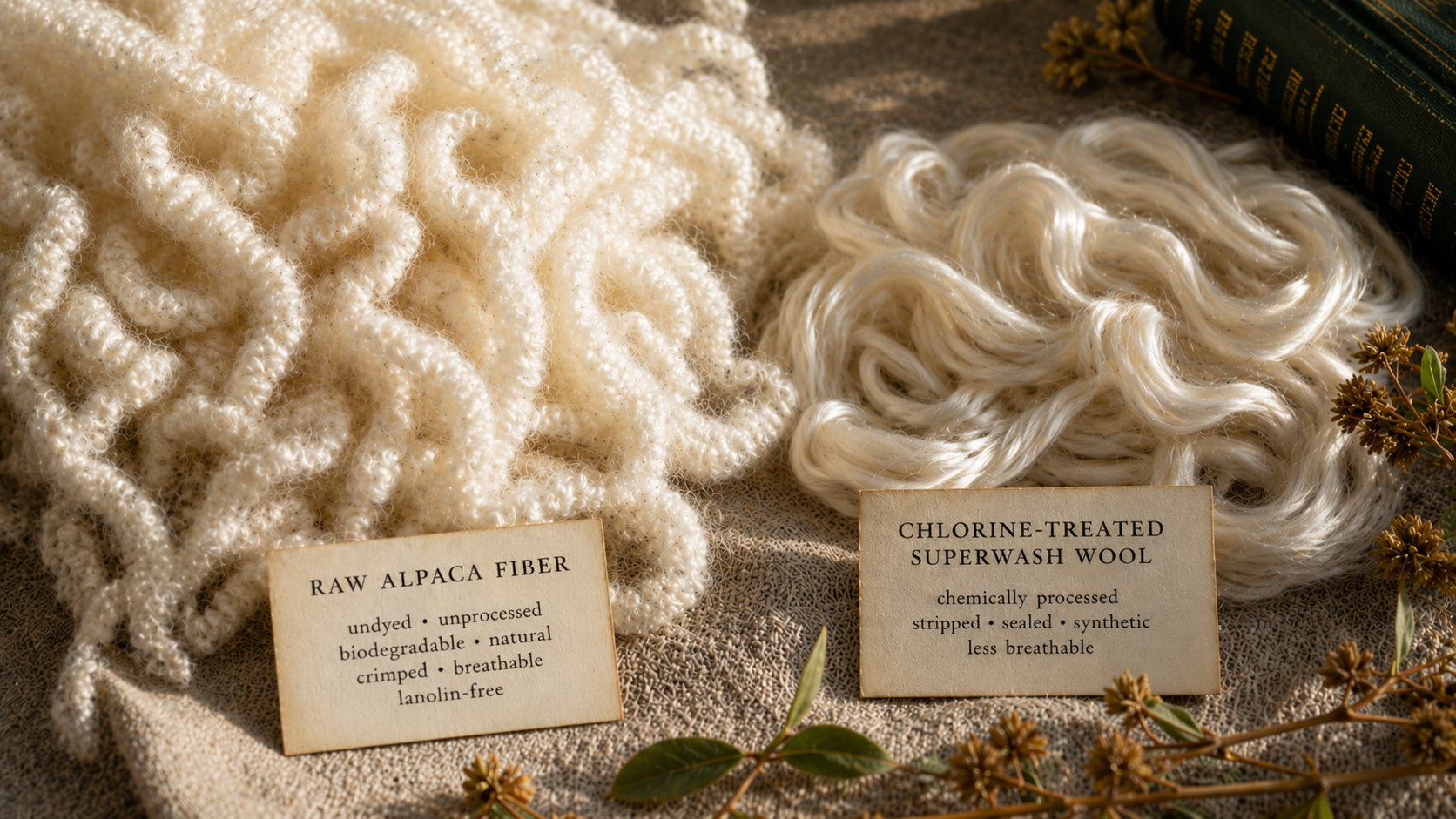
The superwash process was developed to make wool machine washable and therefore more commercially competitive with synthetic fabrics. The most common commercial method uses a chlorinating agent, typically chlorine gas or a chlorinated bath, to erode or degrade the surface scales of the fiber. A second step then coats the fiber in a synthetic polymer resin, most commonly Hercosett, a polyamide-epichlorohydrin compound. This smooth coating prevents the remaining scale structure from catching and felting in the wash. [3,8]
The result is a fiber that passes through a washing machine cycle without significant shrinkage. It is also a fiber whose surface structure has been fundamentally altered, and which now carries a synthetic polymer coating that the finished garment’s label is not required to disclose. A yarn labeled simply “merino” or “wool” may be superwash treated. There is no obligation to say so. [3,4]
The label says wool. The fiber behaves like wool. But the finish is something else, and disclosure is not required.
The Environmental Questions; and What the Research Actually Says
Both steps of the chlorine-Hercosett process generate wastewater containing AOX, adsorbable organic halides, which are toxic byproducts of the chlorination reaction. This is the most thoroughly documented environmental concern associated with superwash processing. In developed countries, industrial AOX discharge is regulated, and treatment is required, but the impact varies significantly depending on where the processing takes place. [8,9]
The question of whether superwash wool sheds microplastics during laundering is not yet settled. Some researchers and fiber industry sources raise it as a meaningful concern, noting that synthetic polymer coatings can degrade with use and repeated washing, releasing particles into wastewater. At least one study examining superwash wool specifically found no microplastic shedding and observed that treated wool biodegraded faster than untreated wool under comparable conditions. The science is still developing, and honest reporting requires acknowledging both sides of that picture. [8,9,10]
What is not in dispute: the superwash process introduces synthetic chemistry into a fiber marketed as natural, and the environmental implications of the processing, particularly the AOX-laden wastewater, are documented concerns that a label will never name.
For us, the unsettled state of the microplastics research is itself the answer. We do not use superwash fiber. That is not a position we arrived at because every question has been resolved; it is a position we arrived at because not every question has been. When a process coats a natural fiber in a synthetic polymer and the downstream effects on water and ecosystems are still being studied, we choose the fiber that requires no such coating. Caution, in fiber as in stewardship, is not timidity. It is the quieter form of proof.
How to Identify Superwash Wool
Superwash wool has a characteristic hand: it tends to feel smoother and often slightly more limp than untreated wool of comparable quality, because the scale structure that gives untreated wool its grip and loft has been reduced. It may carry a slight sheen that untreated wool in the same colorway would not. [8]
A yarn labeled “machine washable” or “easy care” is almost always superwash treated or a synthetic blend. A yarn labeled simply “merino” or “wool” without a machine wash care symbol is more likely untreated, but not certainly so, since disclosure is not required. The most reliable approach is to ask.
Certifications carry the most weight. The Responsible Wool Standard addresses animal welfare and land management but does not govern processing chemistry. GOTS certification covers the entire processing chain and prohibits chlorine-based descaling treatments. If you are purchasing wool because you prefer fiber that has not been chemically modified, GOTS is the mark to look for. [5,6]
Why Alpaca Is a Different Conversation
Alpaca fiber has a smoother shaft with fewer and flatter surface scales than sheep’s wool. This structural difference is why alpaca does not require superwash treatment; the scale architecture that causes wool to felt aggressively under heat and agitation is simply less pronounced in alpaca. The fiber is gentler against the skin for the same reason: less scale height means less friction, and alpaca contains little to no lanolin, the waxy substance in sheep’s wool that can trigger reactions in sensitive individuals. [11,12,13]
This is where accuracy matters, because the gentleness of alpaca is sometimes overstated in ways that lead to damaged fiber and disappointed buyers. Alpaca will felt. It will felt with the combination of hot water, soap, and friction, the same trifecta that causes wool to felt. What alpaca does not require is a chemical modification to make it manageable. The fiber is workable and care-friendly on its own terms. Those terms simply need to be understood.
Alpaca’s gentleness is native to the fiber. But gentleness is not the same as indestructibility. It still asks to be cared for properly.
Protein Fibers and Why Regular Laundry Detergent Is the Wrong Tool
Alpaca, wool, and silk share a fundamental characteristic that sets them apart from cotton, linen, and other plant-based fibers: they are protein fibers. Their structure is built from protein, not cellulose. This distinction matters enormously when it comes to washing.
Cotton is a cellulose fiber, and the most common stains on cotton, food, body soils, grass, are frequently protein-based. Regular laundry detergents are formulated to clean cotton and contain proteases: enzymes specifically designed to break down protein. They do their job very well. But when a protein-based detergent meets a protein-based fiber, it does not stop at the stain. Used repeatedly, it will degrade the fiber itself, weakening the structure of your alpaca, wool, or silk over time in ways that are not immediately visible but that shorten the life of the piece.
Machine washing compounds this problem. The agitation of a washing machine creates exactly the friction and heat combination that causes protein fibers to felt and shrink. High-heat machine drying will cause additional shrinkage and fiber stress. A garment that survives its first machine wash may not survive its fifth.
Protein fibers are not fragile, they are simply different. And caring for them properly is straightforward once you understand what they need.
How to Wash Alpaca, Wool, and Silk
The correct method is a soak, not a scrub. Fill a basin or sink with warm, not hot, water and add a small amount of a detergent formulated for protein fibers. We carry and recommend two products that we use ourselves: Eucalan, a no-rinse wool wash available in several gentle scents, and Unicorn Fiber Wash, a concentrated fiber-specific cleanser that rinses clean and leaves no residue. Both are designed to clean protein fibers without the enzymes that degrade them.
Submerge the garment and allow it to soak for fifteen to twenty minutes. Do not agitate, wring, or rub. Lift the piece gently from the water and press, do not wring, to remove excess moisture. You may roll it briefly in a clean towel to absorb more water. Then lay it flat to dry on a clean surface, reshaping it gently to its original dimensions while it is still damp.
That is the whole of it. No drama, no special equipment, no anxiety. A fiber that has been cared for this way will outlast almost anything in your wardrobe.
Eucalan wool wash and Unicorn Fiber Wash will both be available at Enchanted Forest Alpacas. Ask us at the farm or visit enchantedforestalpacas.com.
What Organic Certification Actually Signals
The word “organic,” when it appears on a fiber label, carries legal weight only when it refers to how the plant or animal was raised, not to what happened afterward. GOTS certification, the Global Organic Textile Standard, goes considerably further, covering both the agricultural origin and every step of the processing chain. It mandates strict environmental criteria at each stage of manufacturing, prohibits hazardous chemical inputs, and requires third-party on-site inspection. For buyers who want the fiber’s processing history to match its origin story, GOTS is one of the most meaningful marks a textile product can carry. [5,6]
Oeko-Tex Standard 100 operates differently — it certifies that the finished product has been tested and found free of harmful substances at levels that would pose a risk to human health, regardless of how the fiber was processed. Both certifications answer the question “natural means what, exactly?” in ways that a hang tag cannot. [5]
A note on our own certifications, because honesty belongs here too: Enchanted Forest Alpacas does not currently hold USDA National Organic Program certification or GOTS certification. We adhere to the standards of both and are actively working toward certification. We name this not as a disclaimer, but as a commitment on the record. Until we carry the certificate, we carry the practice, and we invite you to ask us, at any time, exactly what that practice looks like.
When a label offers you only the word natural without any certification, without a named origin, without a lot number, without a named importer or mill, it is offering you a mood, not a fact. Moods are pleasant. Facts are what protect you.
The Questions Worth Asking
A stewarded purchase begins before you open your wallet. When a fiber or garment carries the word natural, you are entitled to ask:
Where was this fiber grown or raised, and by whom? Was the animal or plant certified, and under what standard? Where was it processed? What finishing treatments were applied, and are those treatments disclosed? Is there a lot number, a mill name, a grading record, or an importer’s mark I can trace?
You will not always receive a complete answer. Brands with nothing to hide tend not to hide very much. But the asking matters, because it trains you to recognize the difference between a story and a supply chain.
What Proof Actually Looks Like
At Enchanted Forest Alpacas, every product that carries a fiber claim also carries the evidence. Our alpaca is labeled with lot numbers and origin notes. Our Peruvian imports come with artisan credits, because we believe the people who made the piece deserve to be named, not erased into a romantic label.
When you hold one of our alpaca socks, our duvets, or our drum-carded batts, you are holding fiber whose story we can tell from the fleece to your hands. Not because we are unusual in our values, but because we believe traceability is the first act of care, and that the words we put on a label should be the beginning of a conversation, not the end of one.
Traceability is the first act of care. The words on a label should be the beginning of a conversation, not the end of one.
Becoming a Reader of Labels
This is not a call to suspicion. It is an invitation to literacy. The natural fiber world is full of makers and farmers and shepherds and spinners who love what they do and who take stewardship seriously. Your curiosity honors their work. Your questions create a market where proof matters more than poetry.
The next time you reach for a garment with a natural claim, reach also for the story behind it. Ask who grew this. Ask what happened next. Ask what certification, what lot, what name stands behind the word.
And when someone can answer those questions with calm specificity and a lot number, you will know you are dealing with something real.
Store opening soon. Explore our traceable alpaca fiber, small-batch yarns, socks, duvets, handcrafted accessories, and fiber care products at enchantedforestalpacas.com.
References
[1] U.S. Federal Trade Commission. Textile Fiber Products Identification Act & Textile Fiber Rule. https://www.ftc.gov/legal-library/browse/rules/textile-fiber-rule
[2] FTC. Threading Your Way Through the Labeling Requirements Under the Textile and Wool Acts. https://www.ftc.gov/business-guidance/resources/threading-your-way-through-labeling-requirements-under-textile-wool-acts
[3] Zakami Yarns. The End of Superwash and the Reason Why. (March 2025) https://zakamiyarns.com/blogs/news/the-end-of-superwash-and-the-reason-why
[4] Making Stories. Why Is Superwash Yarn Not Sustainable? https://making-stories.com/blogs/blog/why-is-superwash-yarn-not-sustainable
[5] Global Organic Textile Standard (GOTS). Key Features & Environmental Criteria. https://global-standard.org/the-standard/gots-key-features
[6] Organic Trade Association. Global Organic Textile Standard (GOTS) overview. https://ota.com/advocacy/organic-integrity-standards/organic-standards/global-organic-textile-standard-gots
[7] Blue Barn Fiber. Superwash Science Stuff — fiber scale structure and wool biology. https://bluebarnfiber.com/pages/superwash-science-stuff
[8] Little Skein Yarn / Anne Vally. The Truth About Superwash Wool Yarn. https://www.littleskein.com/blogs/anne-s-blog/the-truth-about-superwashed-wool-yarn
[9] Northern Playground. Superwash — environmental and microplastic questions. https://www.northernplayground.no/en/product-stories/superwash
[10] Meridian Mill House. Is Superwash Wool Really That Bad? A Realistic Look. https://meridianmillhouse.com/blogs/blog/is-superwash-wool-really-that-bad-a-realistic-look-for-curious-crafters
[11] Wikipedia. Alpaca fiber — fiber structure and scale comparison to wool. https://en.wikipedia.org/wiki/Alpaca_fiber
[12] Warrior Alpaca Socks. Is Alpaca Wool Hypoallergenic? A Guide for Wool Allergy & Sensitive Skin. https://www.warrioralpacasocks.com/blogis-alpaca-wool-hypoallergenic-a-guide-for-wool-allergy-sensitive-skin/
[13] Outdoor Life. Merino Wool vs. Alpaca: Battle of the Base Layers. https://www.outdoorlife.com/gear/merino-wool-vs-alpaca/
[41] MaggieFrameStore. What Is Mercerized Cotton Thread? The Ultimate Guide. https://maggieframestore.com/blogs/maggieframe-news/what-is-mercerized-cotton-thread-the-ultimate-guide-to-strength-shine-smart-applications
[44] OEcotextiles. What Does ‘Mercerized’ Cotton Mean? Environmental impact of sodium hydroxide in textile processing. https://oecotextiles.blog/2012/12/05/what-does-mercerized-cotton-mean/
[46] Sockrates Custom. Explore the 4 Benefits & Properties of Mercerized Cotton. https://www.sockratescustom.com/blog/mercerized-cotton-yarn-explained
[49] Wikipedia. Sanforization — history, process, and dimensional stability. https://en.wikipedia.org/wiki/Sanforization
[52] Grokipedia. Sanforization — mechanical process detail and residual shrinkage standards. https://grokipedia.com/page/Sanforization
enchantedforestalpacas.com | Hersey, Michigan | Sustainable Luxury